- Air Compressors Equipment Offered
- sku: 6781529030448682
- SULLAIR 02250165-315
02250165-315 SULLAIR Module
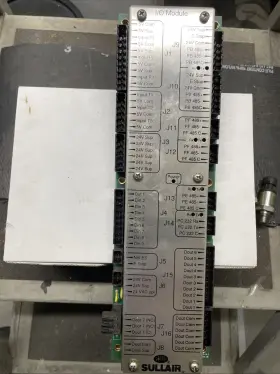
| Brand | SULLAIR |
|---|---|
| Manufacturer Part Number | 02250165-315 |
| Part Type | MODULE |
Review SULLAIR I/o Module
The Sullair 02250165-315 and 02250154-052 I/O Modules are essential components for monitoring and controlling various functions of Sullair compressors. These modules are designed to provide enhanced communication capabilities and improved operational efficiency.
The 02250165-315 I/O Module is a digital input/output module that supports up to 32 input and 32 output signals. It is designed to provide maximum flexibility for connecting various sensors and actuators to the compressor control system. Each input and output can be individually configured for various functions such as alarm notifications, system start/stop, and load shedding. The module also features a built-in RS-485 communication port for connecting to other devices, making it ideal for integrating with building automation systems or other monitoring tools.
On the other hand, the 02250154-052 I/O Module is a relay output module that supports up to 16 normally open and 16 normally closed output contacts. It is designed to provide direct control of various external devices such as solenoids, motors, and heaters. Each output contact can be individually configured for various functions such as pressure control, temperature control, and sequencing. The module also features a built-in status indicator for each output contact, making it easy to monitor the status of connected devices at a glance.
Both I/O Modules are designed to operate in harsh industrial environments, with a wide operating temperature range of -40 C to 70 C and a high degree of protection against dust and water ingress. They are also designed to be easily integrated into existing Sullair compressor control systems, making them a cost-effective solution for expanding the functionality of existing compressor installations.
In summary, the Sullair 02250165-315 and 02250154-052 I/O Modules are versatile and powerful components for monitoring and controlling various functions of Sullair compressors. They offer maximum flexibility for connecting sensors and actuators, as well as direct control of external devices. With their rugged design and easy integration into existing systems, these modules are an essential tool for optimizing the performance and efficiency of Sullair compressor installations.
The Sullair 02250165-315 and 02250154-052 I/O modules are essential components for Sullair compressors, allowing them to interface with various control systems. Here are some pros and cons that could help in deciding whether to purchase these parts.
Pros:1. Enhanced functionality: These I/O modules provide advanced features and capabilities, enabling better monitoring, control, and communication between the compressor and other systems.
2. Improved efficiency: The modules contribute to optimizing compressor performance, reducing energy consumption, and minimizing downtime.
3. Compatibility: They are designed specifically for Sullair compressors, ensuring seamless integration and reliability.
4. Durability: The I/O modules are built to withstand harsh industrial environments, ensuring long-term performance.
Cons:1. Cost: These I/O modules can be relatively expensive compared to other components, making them a significant investment.
2. Complexity: Installing and configuring these modules may require specialized knowledge and expertise, leading to additional labor costs.
3. Availability: Depending on the specific model and availability, there could be delays in receiving the modules, which might impact compressor downtime.
In conclusion, the Sullair 02250165-315 and 02250154-052 I/O modules offer several advantages, including enhanced functionality, improved efficiency, compatibility, and durability. However, their relatively high cost, complexity, and potential availability issues should be considered before making a purchase.
If the benefits of these modules align with your specific compressor application and budget, they could be an excellent investment in maintaining optimal compressor performance and efficiency. If not, it may be worth considering alternative solutions or waiting for better availability and pricing. Ultimately, the decision should be based on your unique requirements and priorities.
Details:
Used i/o from running unit.
specifications compressorshow:
- brand: Sullair
- mpn: 02250165-315
- part type: Module
seller compressorshow:
- city: westminster, massachusetts
- rating: 100.0%
- # reviews: 1051
payments compressorshow:
- credit card: diners-club
- other
- wallet: paypal
general compressorshow:
- category: Business & Industrial > Hydraulics, Pneumatics, Pumps Plumbing > Blowers > Air Compressors
offer compressorshow:
- prices: $300.00–$1995.00
- item condition:
- Used
- New – Open box
- options: ship-to-home
- started: september 28, 2025
- availability: in stock
- sold #: 19
- in stock #: 2
- best offers: true
returns compressorshow:
- policy: no returns
shipping compressorshow:
- service: usps ground advantage
- carrier: usps
- type: calculated
- class: standard
- transit: 5-10 days
Similar Items:
- Sullair 02250071-152 Supervisor Ii Controller Display Module As such, it is being sold as-is. Shipping, items are shipped via USPS or ups. Please refer to the pictures provided as they are a vital part of this listing and show more detail on condition item. Please see the photos for more detail. By buying on this offer, you are taking the risk that item may ...(February 4th, 2024)
- Sullair 02250141-089 I o Module Tested Fully Functional Has surface corrosion on cover but fully functional...(May 19th, 2024)
- Sullair 02250154-051 User Interface Module 24 Vdc Digital Display The SW controller is in working condition. 02250154-051, designed for use with Sullair air compressors. This SW module is a critical component that enables communication between the compressor control system and other devices. For sale is a genuine Sullair SW user interface module controller part no...(June 24th, 2025)
- Sullair 02250119-330 Supervisor Controller Display Module Used tested Sullair supervisor controller display module p/n 02250119-330...(August 29th, 2025)
